Based in Arlington, TX. Serving any business, anywhere.
  (901) 490-4750
  contact@uicompass.com

Squarespace is $200 a year. Wix is similar. Shopify is more.
We are $1,800 a year, managed.
The eight-times difference is real and the comparison gets asked at every sales call. The honest version of the answer is below, with the trade-offs both ways.
What the $200 buys
Squarespace, Wix, and Shopify all sell the same basic product. You pay the platform a monthly fee. You get a drag-and-drop editor. You pick a template. You swap in your content. The platform hosts the site. You are the developer, the designer, the writer, and the IT department.
For that fee you get:
- The editor.
- The hosting.
- A basic SSL certificate.
- A free domain for the first year (then $20–$30/yr after).
- A handful of integrations (Stripe, MailChimp, Calendly).
- A theme that looks like a Squarespace site.
That is a real product. It works. Hundreds of thousands of small businesses use it. We have never argued otherwise.
What the $200 does not buy
Three things that matter for most small businesses.
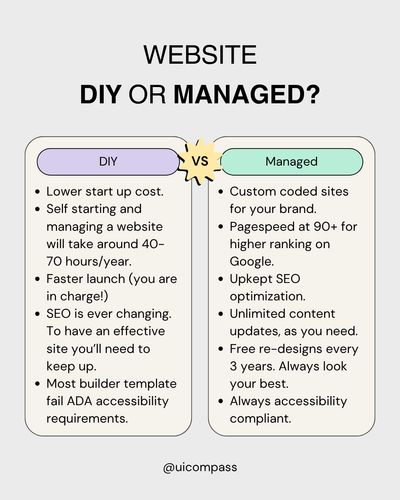
Speed under one second on mobile. Page-builder sites typically land between PageSpeed 50 and 70 on mobile. The platform is built for editor convenience, not for raw delivery speed. The visitor pays the cost on every page load. A one-second delay drops conversions about 7 percent. Most builder sites are 3–6 seconds slower than they need to be.
Competitive local SEO. Builder platforms include "SEO settings" panels that handle page titles and meta descriptions. They do not handle the deeper structural work: NAP consistency, location schema, service-area mapping, internal linking strategy, content velocity. For low-competition niches it is enough. For competitive ones (plumber, attorney, photographer, contractor in any major metro) it is not.
ADA accessibility. Most builder templates fail basic WCAG 2.2 AA contrast and form-label requirements. Most owners do not realize this until a demand letter arrives. Settlements run $5K to $25K. Fixing the templates retroactively is harder than building accessible from the start.
The hidden cost: your time
This is the one nobody factors in correctly.
A standard Squarespace site takes most small business owners 25 to 40 hours to build. In a given year, a standard website may incur around 30 hours of maintenance work. To start out, you'll be:
- Picking a template.
- Writing the copy for every page.
- Finding or buying images.
- Setting up the contact form and testing it.
- Playing around with the editor to get it to do what you want.
- Fixing the mobile breakpoints that look wrong.
- Setting up analytics.
Plus, after launch, the recurring tax:
- An hour a month fixing minor bugs.
- A weekend every quarter when you update content.
- A full day every year for the platform update that breaks one or two things.
Squarespace or Wix will charge you $200, but you are doing the heavy lifting.
At $50 an hour, 40 launch hours + 30 ongoing hours per year = $3,500 in year one labor. After year one, $1,500/yr in ongoing time. In practice, the actual year-one labor cost is approximately $3,700.
What our $1,800 buys
Our managed alternative looks like this:
- A custom-coded site (no page builders, no WordPress) for your business. Not a template.
- Hosting on an edge network with sub-1-second mobile load times.
- PageSpeed scores that rank 90-100.
- Real local SEO: schema markup, NAP consistency, service-area mapping, internal linking.
- Accessibility compliance from day one. WCAG 2.2 AA passing.
- Unlimited edits. Just let us know and we'll change it. No DIYs.
- Security patching, uptime monitoring, broken-link cleanup, all silent.
- A free redesign every three years so the site never gets dated.
Your time cost: a few minutes per email asking for an edit. Total in year one: maybe 5 hours. Maybe.
At $50/hr, that is $250 in your labor. Plus $1,800 in our fee. The total cost one year into launch would be: $2,050.
DIY cost in year one: $3,700. Managed cost in year one: $2,050.
Managed wins on total cost. In year two it widens further.
When DIY is the right call
Four cases:
- Pre-revenue. Early stages of the business (no customers, no revenue). Start with a $10 domain and test the waters. Upgrade later.
- You enjoy the platform. Some owners enjoy the building. The site is a hobby project.
- One product, one page. A weekend launch for a single offer. Carrd or a single Squarespace page is genuinely the right tool.
- You need it live in 48 hours. Agency's typically can't ship that fast. DIY can.
If you are in one of those four buckets, DIY is the right call. If you are not, the math usually says hire it out.
The "I will just learn it" trap
The most expensive version of this decision is the one where the owner says "I will just learn Squarespace, it cannot be that hard."
It is not hard. It is time-consuming. And the time keeps coming. The platform updates. The plugin you used last year is deprecated. The form integration breaks. The image suddenly displays at the wrong size. Each fix is small. The cumulative drain is large.
Conclusion: How to decide
Ask yourself two questions:
1. Are you in one of the four "DIY is genuinely right" buckets? If yes, DIY.
2. Do you value your time at more than $50 an hour? If yes, managed beats DIY on year-one math. If no, the comparison is closer and you can run it on the platform.
A website is either a tool you manage or a service you delegate. Squarespace charges less because you're doing the work. We charge more because we're doing the work.
Once you put a dollar value on your time, the gap is often much smaller than it appears—and for many business owners, the managed option ends up costing less overall.
The question isn't whether a website costs $200 or $1,800.
The question is: Who is going to spend the next 70 hours making sure it works?
Frequently asked questions
I am cheap. What is the cheapest path that still works?
Domain ($10/yr) plus a single-page Carrd or Cargo site (~$50/yr) plus your own contact email (free with the domain). Total: $60/year. Fast, simple, no plugin maintenance, and you own the domain. Works for one-person service businesses with strong word-of-mouth referrals. Stops working when you need more than two pages of content.
What is the actual time cost of DIY?
Plan for 25–40 hours to get a passable Squarespace or Wix site live, including content writing, image sourcing, layout choices, and the inevitable late-night fixing of a broken section. Most owners we have asked say it took longer than they expected. If your time is worth $50/hr, that is $1,250 to $2,000 of opportunity cost. Often more than the managed alternative.
Why is Squarespace slower than a hand-coded site?
Two reasons. The platform ships a lot of framework code that every page has to download. And the platform optimizes for editing, not for serving fast. Your visitor pays the editing convenience tax on every page load. The structural speed gap is about 10x. Not configurable.
Can I move my Squarespace site to hand-coded later?
Yes, and we do this regularly. The content moves over in a day. The redesign and rebuild take two to three weeks. We move the domain, the email, and the content. The platform fee stops the month we are done. Most clients break even on the move within 4–6 months because the new site converts at a measurably higher rate.
Are there cases where DIY is genuinely the right call?
Yes. Pre-revenue businesses, businesses that need a website live this week, businesses with one product and one URL to share, and businesses where the owner enjoys the platform and has the time. The mistake is using "I should DIY to save money" as the reason when none of the above apply.
What about Webflow? It is somewhere in the middle.
Webflow is the strongest DIY platform on the market for performance and design control. Sites can hit PageSpeed 90+ if built carefully. Cost is $300–$600/yr for the platform plus your time. It is the right answer for design-heavy small businesses with someone in-house who knows it. For most small businesses without that, the managed model still wins on time-to-launch and ongoing maintenance.