Based in Arlington, TX. Serving any business, anywhere.
  (901) 490-4750
  contact@uicompass.com


How to get Google traffic to your site
A typical starter website has around 6 pages - Home, About, Services, Contact and maybe some Reviews or Portfolio galleries. However, that simple structure fails to direct local Google search traffic. Why?
It’s a numbers game. Google ranks each page on your website individually. When someone conducts a Google search, Google looks for the single page that most directly answers the prompt. Therefore, if your website has a “Services” page listing all 10 of your services (ie. interior painting, exterior painting, residential painting etc.), it will lose out to the site that has a specific page dedicated to each service.
The best way to optimize your website for Google traffic is to dedicate pages to each potential prompt that your client will search for. Additionally, add around 400 words describing the service, and make sure to add the location.
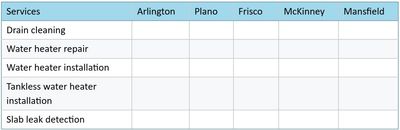
This is what we call a “service-by-location matrix”. If you want to learn more about how to set up your website to best utilize the service-by-location matrix, check out our next blog post.
Understanding Search Intent for SEO Optimization
In SEO, search intent is the primary goal of the user - the “why” behind the search. When a homeowner wants to hire a company to paint their fence, they may search “fence painting XYZ city” or “residential painting XYZ city”. Though they look similar, these two searches have different intent, in the eyes of Google.
In order for your website to pull up before others for either of these prompts, you must have one page dedicated to “fence painting” and another for “residential painting”. A focused page enables better keyword optimization for specific intent, making it easier for AI to understand and rank the content.
Keep in Mind the Client’s Perspective
The vocabulary mismatch between how businesses describe themselves and how customers describe their problems is the unsung reason most small business sites under-rank.
A homeowner with a clogged drain is more likely to search "drain unclogging," not "residential drainage services." A homeowner with a busted water heater may search "water heater not working," not "domestic hot water system service." The header on each page should match how customers talk, not how the industry would describe the service.
Frequently asked questions
Is this "doorway page" SEO that Google penalizes?
It is doorway-adjacent if you do it lazily. The penalty trigger is thin, near-duplicate pages with the suburb name swapped in. Google's guideline says doorway pages are "sites or pages created to rank highly for specific queries that lead users to less useful intermediate pages." The fix is making each page genuinely useful: unique opening, real local detail (a landmark, a known issue in that suburb, a recent project), local proof (a testimonial from a customer in that area). Pages that pass that bar rank because they deserve to.
How do I know which suburbs have enough demand to justify a page?
Three signals. (1) Population — above 100,000 generally has enough native search volume to support a dedicated page. (2) Google Trends — query volume for "your-service + suburb-name" gives you a relative read. (3) Your own job log — if you have done jobs in a suburb in the last 12 months, the demand is real, regardless of what Trends shows. Use the job log as the truth; use population and Trends as the planning aid.
What does a "regional" page look like for grouped smaller suburbs?
A single page titled around the broader region (e.g., "Plumbing in North Tarrant County") that names the smaller suburbs as service areas inside the body. Each named suburb gets a paragraph or a card with a real photo, real customer name, or real local detail. Internal links from this regional page to your service hub. The regional page is one URL doing the work of 5–8 small suburb pages without the thin-content risk.
How fast can I build out 30–60 location pages without it taking 3 months?
Two principles. (1) Ship the highest-demand cells first. Your top 3 services × your top 5 suburbs is 15 pages — start there and the matrix delivers most of the revenue lift before half the work is done. (2) Use templates for layout but write unique copy. The hero section, the trust block, and the closing CTA pattern from our seven-section homepage can be reused; the middle 300 words have to be genuinely about the cell.
Does this kind of site-wide expansion hurt PageSpeed?
Not if the pages share a build pipeline. Static hand-coded sites generate each page at build time, ship as pre-built HTML, and cost almost nothing in performance per added page. WordPress sites with 60 location pages can run into database-assembly slowdowns, especially under the same plugin-heavy setup that gives them the 60-second build time in the first place. Plan the structure before scaling the count.
How does this connect to Google Business Profile?
They reinforce each other. Your GBP listing covers the primary location. Your location pages cover the surrounding suburbs your physical address does not. Google reads both signals — the GBP entity, plus the suburb-specific URLs with consistent NAP — and broadens the area you can rank for. Pair with the 9 GBP secondary categories and the clean NAP rules for the full local-SEO stack.
What about customers who Google "trade-name near me" instead of naming a specific suburb?
"Near me" searches resolve to the searcher's geo-coordinates, which Google maps to a specific suburb or neighborhood. A "plumber near me" search from a phone in Plano is functionally the same as a "plumber in Plano" search. The page-per-suburb model captures both because the suburb-specific URL is the one Google has the highest confidence ranking for that geographic intent.
How long until the new pages start ranking?
Same realistic 4-to-8-week window as other local-SEO foundation work. Google crawls and indexes the new URLs first, then begins assigning rank as it confirms NAP signals and accumulates engagement data. Pages that match all three foundations (clean NAP, sufficient depth, real local proof) usually start ranking around week 6. Pages that fail one of the three can take 3–6 months to settle, or never make it to page 1.